
News & Insights
When to Use Low-Code Application Development


A low-code application development platform lets people build working applications from visual components, connectors and configuration rather than from source code, and it has become the default answer to any internal request that a spreadsheet is currently holding together. It is genuinely faster for a defined set of problems, which is why our software engineering practice delivers both low-code and conventional builds rather than treating one as the answer to everything.
This guide covers what these platforms actually provide, the five situations where they pay off, where a conventional build is still the right call, the risks that do not appear in a demonstration, and a simple way to decide project by project.
What a Low-Code Application Development Platform Actually Gives You
Strip away the marketing and these platforms provide four things.
- A visual builder for screens and logic: Forms, lists and rules assembled from components instead of written by hand. This is the part that produces the speed difference.
- Connectors to other systems: Pre-built links to common databases, mail, storage and enterprise applications, so integration becomes configuration for the systems the vendor supports.
- A workflow engine: Routing, approvals, escalations and timers as a managed capability rather than something you build and then have to operate.
- A runtime and hosting model: The platform runs the application, handles scaling and applies updates. That convenience is also the dependency you are taking on.
What they do not remove is the work of deciding what the application should do, modelling the data correctly, testing it, and integrating it with systems the vendor has no connector for. A badly specified process delivered quickly is still a badly specified process.
5 Places Low-Code Delivers
- Replacing a spreadsheet that has become a system: A shared file with macros, version conflicts and one person who understands it. These are small, well-understood processes with a clear owner, and they convert cleanly.
- Approval workflows that cross departments: Requests that travel by email with no audit trail. Routing, delegation and a record of who approved what is exactly what the workflow engine is for.
- Case and request management: Onboarding, claims intake, facilities requests, compliance checks. Structured data, a defined lifecycle and status visibility, without a bespoke build.
- A usable front end over an existing system: Where the system of record is sound but its interface is not, a low-code layer can give a specific group a simpler screen without touching the underlying system.
- Testing a process before committing to it: Building the real thing in weeks tells you more about whether a process works than a specification review will. If it proves out, you then decide whether it stays as-is or gets built properly.
The pattern is consistent: bounded scope, modest transaction volumes, an internal audience, and a process that is going to keep changing.
Where Traditional Development Still Wins
High transaction volumes and tight performance requirements. Platform runtimes add overhead and limit how far you can tune. If the application processes large volumes or has hard response time requirements, that constraint will surface late and be expensive.
Complex domain logic. Calculation-heavy work, intricate rules with many exceptions, or algorithms that need to be unit tested exhaustively are easier to express, review and maintain in code.
Anything you sell. If the application is a product or a customer-facing differentiator, per-user licensing and the vendor’s roadmap become part of your commercial model and your ceiling.
Demanding user experience. Consumer-grade interfaces, unusual interaction patterns and heavy offline or mobile requirements run past what component libraries do well.
Long-lived systems with strict portability requirements. Where a system must run for a decade and survive vendor changes, code you own is a different kind of asset from a configuration that only executes inside one platform.
The Risks That Do Not Appear in the Demonstration
The licence curve. Pricing that looks trivial for one department changes shape at a thousand users or when external parties need access. Model the cost at the scale you expect in year three, not at pilot scale.
Exit. Ask specifically what you can export and what that export is worth. Business logic expressed as platform configuration generally does not transfer to anything else, so rebuilding is the realistic exit path. That is acceptable for a three-year internal tool and a poor position for a core system.
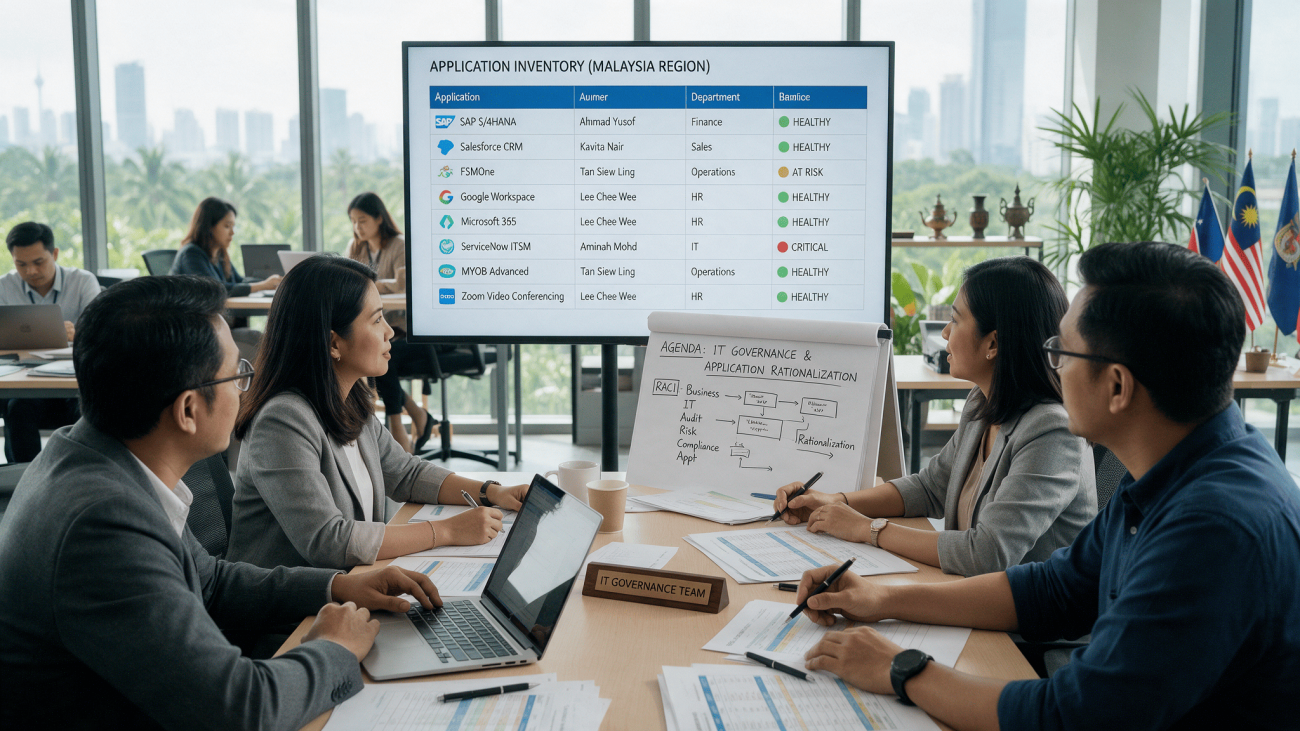
Sprawl. The same ease that makes the first application quick produces sixty applications in two years, a third of them abandoned, several holding personal data nobody registered. This is the most common failure, and it is a governance problem rather than a technical one.
Upgrade cycles you do not control. The vendor updates the platform on its own schedule. Applications validated for a regulated process may need retesting when that happens, and the timing is not yours.
Engineering discipline. Source control, environments, automated testing and release management are weaker or different on most platforms. Teams that skip them because the tool makes it possible end up with production changes nobody reviewed.
Governance That Keeps It Useful
Low-code programmes fail from neglect more often than from technology. Five controls prevent most of it.
- Keep a register of every application. Name, owner, purpose, data it holds, systems it touches. Without this you cannot answer a regulator’s question or decide what to retire.
- Tier applications and govern accordingly. A personal productivity tool needs almost no oversight. A team application needs an owner and a backup. An application supporting a business-critical or regulated process needs the same review, testing and change control as any other system of that class.
- Decide who may build, and train them. Citizen development works where the platform is open to trained business users within guardrails, and fails where anyone can publish anything to production.
- Apply data rules at the platform level. If an application collects personal data, the Personal Data Protection Act 2010 applies to it exactly as it would to a system built in the usual way, including the duties in force since 1 June 2025 to appoint a data protection officer and to notify the Commissioner of breaches. Financial institutions should also expect these applications to fall within Bank Negara Malaysia’s technology risk expectations. Check where the platform stores and processes data before the first application is built, not after.
- Review the estate on a cadence. Twice a year, retire what is unused, reassign what has lost an owner, and promote anything that has quietly become critical to a governed tier.
How to Decide, Project by Project
| Question | Points to low-code | Points to a conventional build |
| Who uses it | Internal teams, known user count | Customers, public, or an open-ended user base |
| Transaction volume | Low to moderate | High, or with strict response time requirements |
| Logic complexity | Forms, routing, status, straightforward rules | Calculation-heavy, many exceptions, needs exhaustive testing |
| Expected lifespan | Two to five years, changing often | A decade, with stability more valuable than speed |
| Integration needs | Systems the platform already connects to | Bespoke or legacy interfaces with no connector |
| Commercial role | Supports internal work | Is the product, or a differentiator you sell |
| Exit tolerance | Rebuilding later is acceptable | You must be able to take the system with you |
If the answers split evenly, build the first version in low-code with a written note of what would trigger a rebuild. Deciding that trigger in advance is what keeps the decision reversible.
Where Strateq Fits
We build applications both ways, which is the only position from which the advice above is worth anything.
Our software engineering practice covers low-code application development alongside conventional development, application modernisation, enterprise integration and enterprise architecture, so a project can start low-code and move if it outgrows the model. Where the requirement is workflow-heavy and crosses several systems, we are a certified partner for the Nintex Automation K2 platform, which is built for regulated enterprises that need control over where data lives and which components handle it.
The part organisations usually underestimate is integration with what they already run, and that is where we have the advantage, having worked as a system integrator with Malaysian enterprises since 1983. We also deliver the enterprise business software that low-code applications generally have to talk to, including ERP, financials, reconciliation and e-Invoice.
If you have a shortlist of internal applications and no agreed basis for choosing between them, run them through the table above and bring the contested ones to our software engineering team.