
News & Insights
How to Choose a Data Centre in Malaysia: An Enterprise Checklist

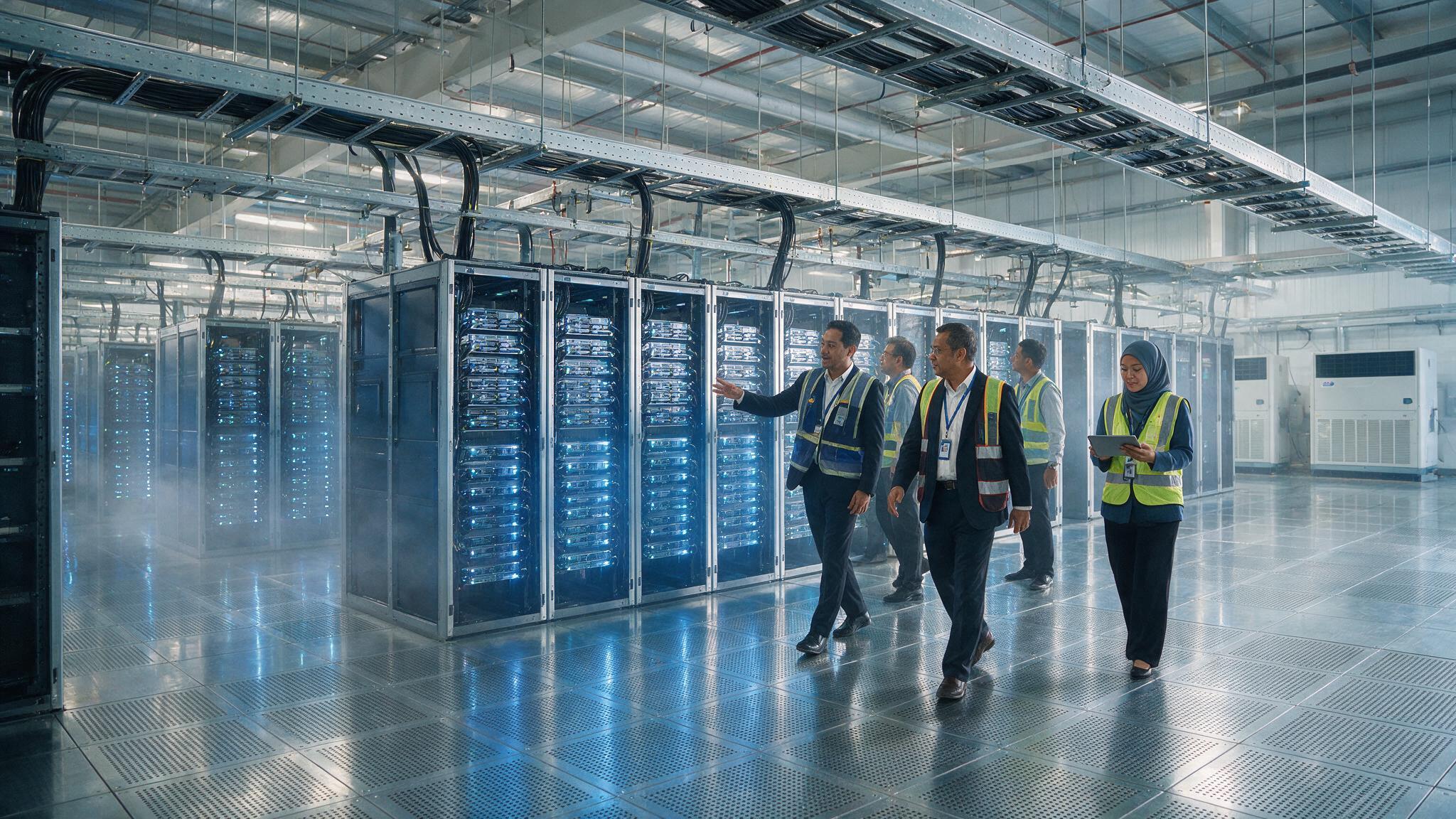
Choosing a data centre in Malaysia is not a simple procurement exercise. It is a decision about where your production systems will physically sit for the next five to ten years. This guide gives you a vendor-neutral framework: the seven areas that actually separate facilities, and the documents to ask for so you can verify each claim yourself.
Most shortlists go wrong at the first step, because the buyer starts comparing facilities before defining what the workload needs. You end up paying for resilience you don’t need in one place and discovering a hard constraint in another.
Fix three numbers before you take a single site tour:
1. Recovery time objective (RTO): How long can this system be unavailable before the business takes real damage? Is it measured in minutes, hours, or a working day? Be specific per system, not per company.
2. Recovery point objective (RPO): How much data can you afford to lose, expressed in time. A payments system and a document archive do not get the same answer.
3. Growth: Racks and kilowatts you need on day one, and what you expect in 36 months.
What to Look for in a Data Centre in Malaysia: 7 Decision Areas
1. Certification and design, and what “Rated-3” actually means
Two different schemes get used loosely and interchangeably in this market, and the difference matters when you’re comparing bids.
ANSI/TIA-942 is a telecommunications infrastructure standard for data centres, managed by the Telecommunications Industry Association (TIA). Its resilience levels are called Rated-1 to Rated-4. A Rated-3 facility is broadly one with redundant capacity components and multiple distribution paths, so planned maintenance can be carried out without taking the load down.
Uptime Institute Tier certification is a separate, independently awarded scheme with its own Tier I–IV classification, and it is awarded per design, per constructed facility, or per operational sustainability.
They are not synonyms, and a provider certified under one is not automatically certified under the other.
2. Availability and SLA: What the number actually guarantees
An availability percentage is a commercial promise. Before you compare, establish what each one is measured against.
- What is being measured — power at the rack, network availability, the provider’s own managed service layer, or all three under one figure?
- How downtime is calculated — from first alert, from ticket acknowledgement, or from your own report? Rounded to which interval?
- What is excluded — planned maintenance windows, upstream carrier faults, force majeure, anything caused by your own equipment.
- What the remedy is — service credits are the norm, and service credits are not compensation for business loss. Read the cap.
A 99.99% headline with three pages of exclusions is weaker than a 99.9% commitment measured end to end. Ask for the SLA schedule as a document, not as a slide.
3. Location, connectivity and latency
In Klang Valley, the practical questions are flood exposure, distance from your primary site, and how you actually reach the building.
Ask which electricity substations feed the site and whether the feeds are independent. Ask what the flood history of the immediate area is. If you’re placing a disaster recovery site, ask for the distance and the separation logic between primary and secondary: far enough apart to survive the same regional event, close enough that your team can physically get there and that synchronous replication still performs.
On connectivity, the thing that matters is choice. Is the facility carrier-neutral, and how many carriers are actually lit in the building today? Is there MyIX peering available for domestic traffic? What are the cross-connect charges, and what does it cost to add a second carrier later?
4. Power and cooling headroom
Ask for the power density available per rack in the specific hall you are being offered, then compare it against what your newer hardware actually draws. High-density and AI-adjacent workloads have moved this number a long way in a short time. Ask what happens when you exceed the contracted draw: is it a hard cap, a surcharge, or a conversation?
Then ask about redundancy on both power and cooling — UPS configuration, generator configuration, fuel autonomy in hours, refuelling contracts, and the last date the generators were load-tested. Ask whether cooling redundancy matches power redundancy, because facilities where they don’t match are common and the mismatch is where availability quietly leaks.
5. Physical security and access control
Look for layered control: perimeter, building, hall, cage, rack. Ask who is on site overnight and whether they are contracted guards or a formal security force. Ask how visitor access is authorised, how long access logs and CCTV footage are retained, and whether photography is permitted inside the halls.
Ask whether the facility carries any government security designation. In Malaysia, a CGSO-declared Protected Area / Protected Place (Chief Government Security Office, Prime Minister’s Department) is a meaningful and checkable distinction, and it comes with restrictions on who may enter and independent security audits. Ask for a valid Bomba Fire Certificate and the fire suppression design for the halls.
6. Compliance and audit support
Certifications belong to a scope and a date. Get both.
- ISO/IEC 27001 — ask for the certificate, and check the scope statement covers the site you are buying, not a head office. Check it is on the current revision of the standard (as at 2026) that is :2022.
- PDPA (Malaysia) — where data is stored and processed, who can access it, and how you are notified of an incident.
- BNM RMiT — if you are a financial institution, the relevant question is whether the provider has been through Bank Negara Malaysia’s Risk Management in Technology expectations before, and can produce the assessment evidence your auditors will ask for.
- PCI DSS — for anything in a card payment flow.
- Assessments — TVRA (threat, vulnerability and risk assessment) and DCRA (data centre risk assessment) reports show the facility has been examined by someone other than its own marketing team.
- Right to audit — is it in the contract, and how much notice does it require?
7. Operating model and support
You are buying an operations team as much as a building. Establish what is included in the base colocation fee and what is billed separately: remote hands, hardware replacement, monitoring, patching, backup management, incident response.
Ask who answers at 3am on a public holiday — an on-site engineer, an offshore service desk, or a voicemail. Ask what the escalation path is, and how many people hold the relevant certifications.

How to verify the claims yourself
Request these six documents:
- The certification certificates — ISO/IEC 27001 (with scope statement), ANSI/TIA-942, PCI DSS, Bomba Fire Certificate.
- The SLA schedule with definitions, exclusions and credit caps.
- The single-line electrical diagram for the hall you are being offered.
- The most recent TVRA / DCRA assessment summary.
- The generator load-test and maintenance log for the last 12 months.
- The carrier list for the building, with cross-connect pricing.
On the walkthrough, ask to see the loading bay, the plant rooms and the fuel store. Watch how your own escort is authorised at each door.
The commercial terms people forget
- Growth: Is there a contractual right to expand within the same hall, at a pre-agreed rate? If not, your third-year expansion is negotiated from a position of zero leverage.
- Exit: How much notice, in what form, and who pays for what on the way out. Confirm that the provider will support a structured migration, and that your data-bearing media are returned or destroyed to a documented standard.
- Continuity of the arrangement: Ask about software escrow, offsite media storage and secure media transportation if any part of your recovery depends on assets held by a third party.
The enterprise data centre checklist
Here’s a handy checklist you can take to your provider shortlist:
| # | Check | What good looks like | Evidence to request |
|---|---|---|---|
| 1 | RTO / RPO / growth defined | Documented per system before the first site visit | Your own requirements sheet |
| 2 | Certification scheme and rating | Named standard, rating, revision, site and date | Certificates |
| 3 | Availability commitment | Measured end to end, exclusions understood | SLA schedule |
| 4 | Site risk | Independent substation feeds; street-level flood history | Single-line diagram, site risk assessment |
| 5 | Carrier neutrality | Multiple carriers lit today; MyIX peering available | Carrier list, cross-connect pricing |
| 6 | Power density per rack | Meets your current draw with headroom for 36 months | Written confirmation for the specific hall |
| 7 | Power and cooling redundancy | Redundant on both, not just power | Design summary, generator load-test log |
| 8 | Physical security layers | Perimeter to rack; overnight staffing named | Access policy, log retention period |
| 9 | Government security designation | CGSO Protected Area / Protected Place where applicable | Designation evidence |
| 10 | Fire protection | Valid Bomba Fire Certificate; suppression design stated | Certificate |
| 11 | Information security | ISO/IEC 27001:2022, scope covers the site | Certificate with scope statement |
| 12 | Sector compliance | BNM RMiT experience, PDPA handling, PCI DSS if in scope | Assessment evidence |
| 13 | Independent assessment | TVRA and DCRA completed and recent | Assessment summary |
| 14 | Support model | 24/7, on site, named escalation path | Service description, certifications held |
| 15 | Continuity capability | Work-area recovery seats; live recovery experience | Reference call |
| 16 | Commercial terms | Expansion rights, exit terms, escrow and offsite options | Contract schedules |
Where Strateq fits
We have been operating data centres in Malaysia since 1989, which makes us one of Malaysia’s pioneer data centre providers.
Our facilities are purpose-built, owned and managed by Strateq rather than leased space in a multi-tenant building: DC1 in Petaling Jaya (~88,000 sq ft), DC2 at i-City, Shah Alam (~24,000 sq ft), and DC3 at Chai Chee, Singapore (~13,000 sq ft). The halls are designed for high resilience with redundant power and cooling.
Our Petaling Jaya data centre is a CGSO-declared Protected Area / Protected Place (Chief Government Security Office, Prime Minister’s Department) — access is restricted to authorised persons, the premises are manned by Auxiliary Police, and unauthorised photography and filming are not permitted. The facility is subject to CGSO security audits and has been audited by Bank Negara Malaysia. We comply with BNM’s RMiT and bring around 30 years of experience in the banking sector.
Accreditations for our Malaysian facilities: ISO/IEC 27001:2022, ISO 9001:2015, ANSI/TIA-942-C (Rated-3), PCI DSS, and completed TVRA and DCRA assessments. We hold a valid Bomba Fire Certificate and operate 300+ business continuity seats for dedicated or shared work-area recovery. Our consultants hold CBCP certification. Partnerships include rhipe, MyIX, APNiC, AWS.
Alongside Private Suite and colocation hosting we run production and disaster recovery hosting and management, IT hardware and systems managed services, data centre fit-out (facility audit, design, project management and DC management), DC relocation planning and execution, offsite storage, media transportation and escrow services, and business continuity consulting — business impact analysis, BCP strategy and plan development, and plan testing and maintenance.
Read more about how we run the facilities on our data centre management page. Contact us for a tour of our facilities today.