
News & Insights
DRaaS vs Traditional Disaster Recovery For Your Business

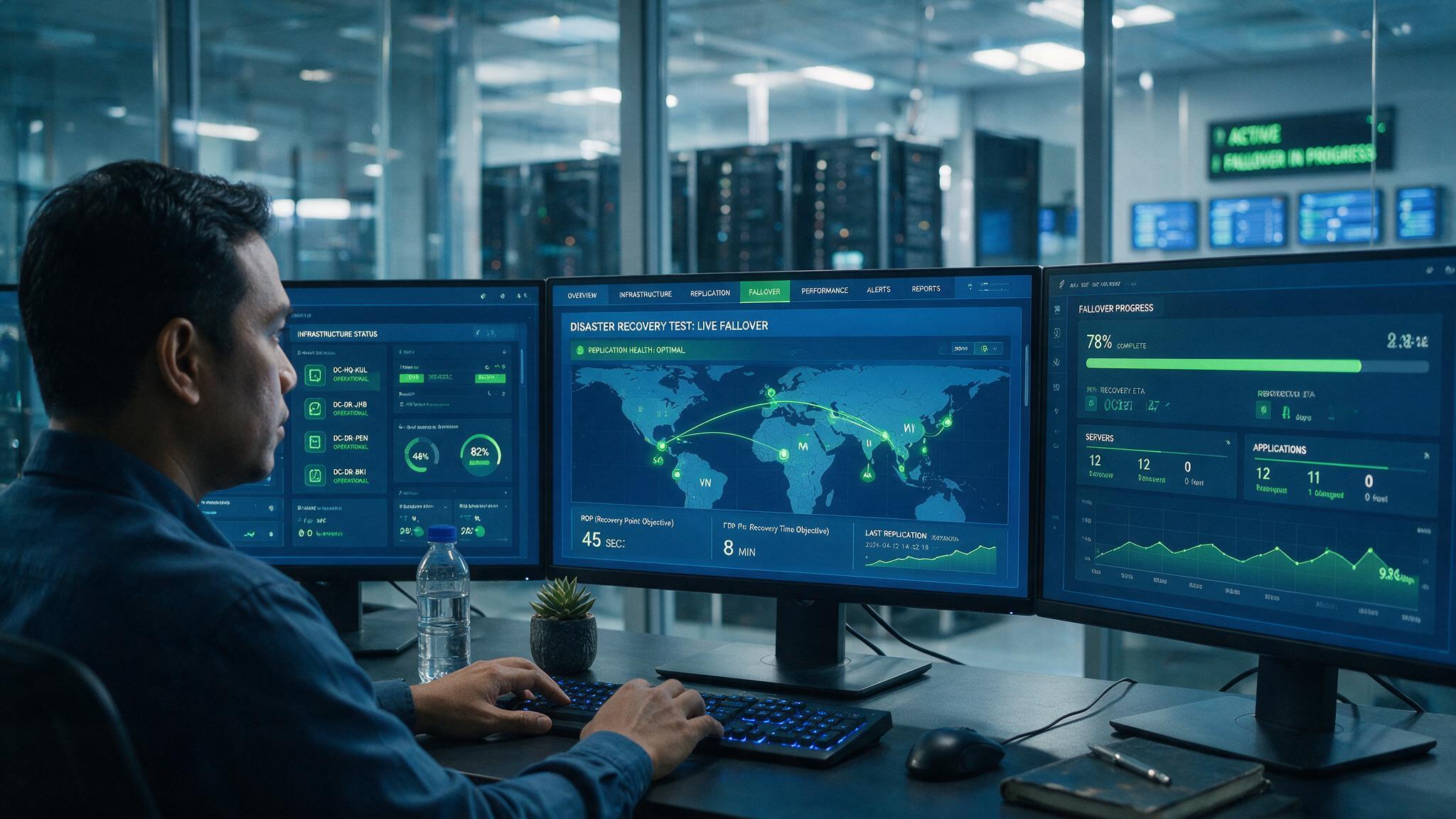
Disaster recovery as a service in Malaysia has become the default option for many businesses, but it is not automatically the right one, and the older model it is replacing, a dedicated secondary disaster recovery site, still has a place for workloads with the strictest recovery requirements. The two models solve the same problem differently: keeping a working copy of your systems ready so a failure at your primary site does not become a failure of the business.
This guide sets out what DRaaS actually is, how it differs from traditional DR, where the cost and recovery-time trade-offs sit, and how to decide between the two based on your company’s size and risk profile.
What Is DRaaS, and How Is It Different From Traditional DR?
Disaster recovery as a service replicates your systems and data to a provider’s infrastructure on a subscription basis. The provider owns and maintains the recovery infrastructure; you pay for the capacity and the service, not for a dedicated site sitting mostly idle.
Failover, the process of switching operations to the recovery environment, is typically automated or semi-automated, and the same recovery infrastructure is usually shared across multiple customers who are not expected to fail over at the same time.
Traditional disaster recovery is a dedicated secondary site, owned or leased by your business, running duplicate infrastructure that mirrors production. It requires its own hardware refresh cycle, its own connectivity, and staff who can operate it during an actual event. Failover is more often manual or semi-manual, run by a team that has rehearsed the specific procedure for that environment.
The practical difference is who bears the fixed cost of readiness. In managed cloud disaster recovery, that cost is shared across the provider’s customer base and billed as a subscription. In traditional DR, your business carries the full fixed cost of a site that, most of the time, is doing nothing.
RTO and RPO: The Two Numbers That Actually Decide the Model
Two figures determine what either model can deliver for you, and they should be set before you compare providers, not after.
- Recovery time objective (RTO): how long the business can tolerate a system being unavailable before the damage becomes unacceptable. This is a business decision, not a technical one, and it varies by system, not by company.
- Recovery point objective (RPO): how much data the business can afford to lose, measured in time since the last successful replication or backup. A four-hour RPO means you could lose up to four hours of transactions in a failover.
A dedicated secondary site, purpose-built and fully mirroring production, can generally be engineered to the tightest RTO and RPO a business is willing to pay for, because nothing about its capacity is shared.
DRaaS can also reach very tight recovery targets, but because recovery infrastructure is shared, actual failover performance depends on the provider’s capacity planning and on how many customers, in the worst case, might need to fail over at once. Ask any DRaaS provider directly how they size shared capacity against simultaneous-failover risk, and ask for the answer in writing.
Neither model has a universal advantage on these two numbers. The advantage depends on how much dedicated capacity you are willing to fund.
Cost Comparison: DRaaS vs Traditional Secondary-Site DR
The cost structures behind the two models run in opposite directions, and the comparison changes with company size.
| DRaaS | Traditional DR | |
|---|---|---|
| Cost model | Operating expense, subscription-based | Capital expense for infrastructure, plus ongoing operating cost |
| Idle-capacity cost | Shared across the provider’s customer base | Borne entirely by your business |
| Staffing | Provider manages the recovery infrastructure | Your team operates and tests the site |
| Scaling | Adjusts with subscription tier | Requires a capital cycle to add capacity |
| Best fit | Businesses without the budget or staff to run a dedicated site | Businesses with strict, non-negotiable RTO/RPO and the budget to fund dedicated capacity |
For a business with a modest IT budget, DRaaS converts a large upfront capital commitment into a predictable monthly cost, which is usually the deciding factor. For a business that already runs 24/7 IT operations at scale, the calculation changes, because the marginal cost of a dedicated secondary site is smaller relative to the size of the operation, and full control over failover timing carries more weight.

How to Verify a DRaaS Provider’s Recovery Claims
A subscription tier name and an advertised RTO are marketing copy until you have seen the evidence behind them. Ask a shortlisted provider for these before signing:
- A recent test failover report for a customer environment comparable to yours, including the actual time taken and any deviation from the target RTO.
- The shared-capacity plan for their recovery infrastructure: how many customers share the environment you would fail over into, and what happens to your RTO if more than one of them declares at the same time.
- The RPO measured at the replication layer, not the backup layer. Continuous or near-continuous replication and periodic backup produce very different RPOs, and providers sometimes quote the better of the two without saying which applies to you.
- The physical location of the recovery infrastructure, so you can check it against your own data-residency and regulatory obligations before you rely on it.
A provider running a genuine DRaaS practice can produce all four without hesitation. Reluctance to share a test failover report is itself useful information.
Choosing Between DRaaS and Traditional DR by Company Size and Risk
Match the model to your regulatory exposure and your recovery requirements, not to what a vendor is selling this quarter.
- Small and mid-sized businesses without a dedicated recovery budget. DRaaS is generally the right starting point. It gives you a tested recovery capability without the capital outlay of a second site, and most providers can meet RTOs well inside what an unprotected business would otherwise face.
- Regulated businesses with strict continuity obligations. Financial institutions working to Bank Negara Malaysia’s Risk Management in Technology (RMiT) expectations, and similarly regulated healthcare or government bodies, should treat RTO and RPO as compliance requirements, not preferences. Confirm in writing that a DRaaS provider’s shared-capacity model can meet the specific targets your regulator expects, not just the targets in their marketing material.
- Large enterprises with systems where minutes of downtime cause material loss. Core banking, payment switching, and similarly critical systems are candidates for dedicated secondary-site DR, or for a DRaaS tier with contractually guaranteed, non-shared failover capacity. A hybrid approach, dedicated DR for the handful of systems that need it and DRaaS for everything else, is normal and usually the most cost-effective outcome.
- Any business handling personal data in a failover. Under the Personal Data Protection Act (PDPA), a failover to a recovery site is still processing personal data, so confirm where the recovery infrastructure physically sits and whether that location satisfies your data-residency obligations, for both models.
DRaaS and traditional DR both answer a narrower question than business continuity does. Recovering IT systems is one part of keeping the business operating; work-area recovery, staff continuity and supplier dependencies sit outside either model and need their own plan.
Where Strateq Fits
We have been operating data centres in Malaysia since 1989, and disaster recovery hosting and management, production or DR site hosting through Private Suite or colocation, is a named service we run directly rather than through a third party.
That service runs across three sites in two countries: DC1 in Petaling Jaya, DC2 at i-City, Shah Alam, and DC3 in Chai Chee, Singapore, which gives DR customers a choice of in-country or cross-border recovery siting depending on their data-residency requirements. Our Malaysian operations are audited by BNM, and comply with BNM’s RMiT expectations, which matters directly if your own continuity obligations sit with the same regulator.
Use the RTO and RPO you set for each system, not a vendor’s default tier, to decide between DRaaS and a dedicated secondary site. Contact us to talk through which model fits your recovery requirements.